White House plan to break up iconic U.S. climate lab moves forward
Bidders have lined up to take over pieces of the National Center for Atmospheric Research
10 Mar 2026 4:00 PM ET By Paul Voosen
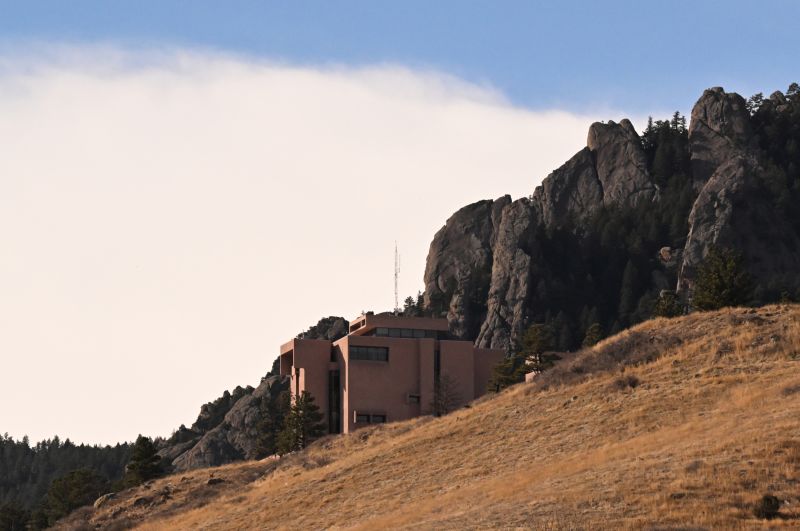
Designed by noted architect I.M. Pei, the Mesa Lab in Boulder, Colorado, houses most of NCAR’s 800 scientists and engineers. Caine Delacy/The New York Times via Redux
In January, the U.S. National Weather Service (NWS) made a surprising announcement: It would change the computational heart of its premier forecast model, which divides the atmosphere into virtual parcels and solves the physical equations that describe how heat and moisture move around the globe. NWS had always relied on “dynamical cores” developed at its parent agency, the National Oceanic and Atmospheric Administration (NOAA). But now, it would turn to a core developed at its longtime peer—and sometimes rival—the National Center for Atmospheric Research (NCAR), the famed weather and climate research lab in Boulder, Colorado.
The news came with no small amount of irony. Just when NCAR was gaining validation and support from one part of the government, another was taking steps to dismantle it. A month earlier, Russell Vought, director of the Office of Management and Budget (OMB), had said the White House would “break up” NCAR, citing its role in “climate alarmism.”
The National Science Foundation (NSF), which funds NCAR, quickly followed OMB’s directive, soliciting bids to take over management of NCAR’s various components from the University Corporation for Atmospheric Research, a nonprofit consortium of more than 100 universities. NSF has received a flood of responses, many of them simple protests from scientists. But serious ideas are on the table. The University of Wyoming (UW), at NSF’s request, will propose taking over an NCAR supercomputing center in Cheyenne. NSF is expected to move two NCAR-operated research aircraft to either NASA or NOAA. And this week, proposals are due to NSF for reconfiguring or dispersing the heart of NCAR—Boulder’s Mesa Lab, the striking building that is home to most of its 800 scientists and engineers. For decades they have researched how storms form, how seasonal weather can be predicted, and how the world will change with the warmer temperatures to come.
Science has learned that one proposal is expected to come from the University of Oklahoma, an academic powerhouse in severe weather research. Another will likely come from Lynker, a NOAA contractor that wants to take over NCAR’s space weather research. The details of the bids are sparse, but atmospheric scientists hope any new scheme will preserve NCAR’s functions and expertise.
“Whatever happens to NCAR, we cannot lose what we get out of it,” says Alan Sealls, president of the American Meteorological Society. “We see a potential threat to one of the linchpins of the weather enterprise.”
UW says it could readily accommodate NCAR’s supercomputing capacity. The university already partners with NCAR to run the center, and the facility has room to grow. UW wants to bring in private investors while still allowing NCAR scientists and other academics to have access. If selected, says UW President Edward Seidel, “We anticipate working with a broad set of partners to steward the supercomputing facility and help broaden out its use, as NSF originally intended.”
Some worry NSF could order UW to shift the supercomputing center’s focus from climate to weather. One of the center’s biggest projects was a collaboration that ran NCAR’s flagship climate model at high resolutions, producing far more accurate forecasts of future rainfall under global warming. Focusing this computing power on short-term weather forecasts alone would be a mistake, says Robert Goldhammer, former emergency manager of Iowa’s Polk County. Insurance companies, emergency responders, and farmers all rely on longer term forecasts that benefit from NCAR’s climate research, he says. “If we don’t maintain our ability to know what’s coming, we’re going to end up paying for it in the end.”
NOAA itself could propose to take on parts of NCAR. NOAA Administrator Neil Jacobs has told researchers that President Donald Trump wants U.S. numerical weather prediction models to catch up to superior European models and be top in the world within the next 3 years, an effort dubbed the “NWP Moonshot” in an internal document seen by Science.
Jacobs, who worked at NCAR after his first stint running NOAA during Trump’s first term, has long pushed for a weather moonshot. By adopting NCAR’s modeling core, Jacobs hopes to spark closer collaboration between academic and government modelers, says Cliff Mass, a meteorologist at the University of Washington. “There’s too many American groups doing weather prediction and too many models splitting the community up.”
Mass has submitted his own proposal that would combine elements of NCAR and NOAA into a nonprofit dubbed the American Center for Weather Prediction Science. Most of NCAR, including its climate research, could continue its work in such a center and still be housed at the Mesa Lab, while the center’s nonprofit structure would allow U.S. companies to invest in the work. But OMB, which has been directing NSF on its actions with NCAR, will make the final call on this and other ideas.
It may face constraints, however, in its plans for the Mesa Lab. Colorado donated the land and Boulder’s residents voted to provide the water on the condition the land was “used to carry out the purposes and functions” of NCAR or NSF, a stipulation first noted by the Boulder Reporting Lab, a local news site. That condition could allow NSF to repurpose the building or transfer its management but could limit its ability to sell it.
And Congress could still thwart OMB. Colorado’s senators discussed adding a provision to this year’s spending bill for NSF that would have protected NCAR, although they failed to do so. But last week, a Senate committee unanimously approved a bipartisan bill to improve weather forecasting that included an amendment to prevent NSF from transferring any NCAR assets until it completes a report to Congress on how the transfer might affect weather prediction. If the bill becomes law—far from guaranteed—it could buy time for lawmakers to place NCAR protections in spending bills for the next fiscal year.
NCAR’s climate research may not be the only thing driving the White House attack. It is widely believed to also be part of a campaign of political retribution waged against Colorado for its conviction and imprisonment of Tina Peters, a former county clerk who breached election security systems in a scheme to find proof of fraud in the 2020 presidential election. The state has included the attack on NCAR in a lawsuit against the Trump administration.
But last week, Colorado’s Democratic governor, Jared Polis, floated the possibility of commuting Peters’s sentence in a social media post. Given Trump’s transactional views on politics, such a move could soften the administration’s views of NCAR. The proposal from Polis drew widespread outrage from state Democratic leaders. But Polis, who is from Boulder and has close ties to NCAR, has been known to buck his party in the past. The fate of one of the world’s most famous climate labs may hinge on backroom bargaining far removed from atmospheric science.
doi: 10.1126/science.zkspho9 |
 楼主: Gillen


 发表于 2025-12-29 15:05:32